The More Time Perfectionists Have, the More They Procrastinate

We assume that having more time means doing better work.
When you see a wide-open afternoon on your calendar, you tell yourself, "Today I'll finally finish that proposal." But strangely, the days you have the most time are the days that end with you thinking, "What did I even do today?"
You opened the proposal, but then you rethought the title, rearranged the subheadings, and tweaked the fonts — and three hours vanished. Did the quality improve? Honestly, the result isn't much different from what you had after the first hour.
This isn't a willpower problem. There's a trap built into the way our brains handle time.
"Work expands to fill the time available for its completion" — Parkinson's Law
In 1955, British historian Cyril Northcote Parkinson published an essay in The Economist. Its opening sentence became one of the most quoted principles in management and psychology for decades to come.
"Work expands so as to fill the time available for its completion." — Cyril Northcote Parkinson
The core of Parkinson's Law is simple. Give yourself two weeks, and it takes two weeks. Give yourself three days, and it gets done in three. It's not the actual complexity of the work that determines how long it takes — it's the amount of time you've been given.
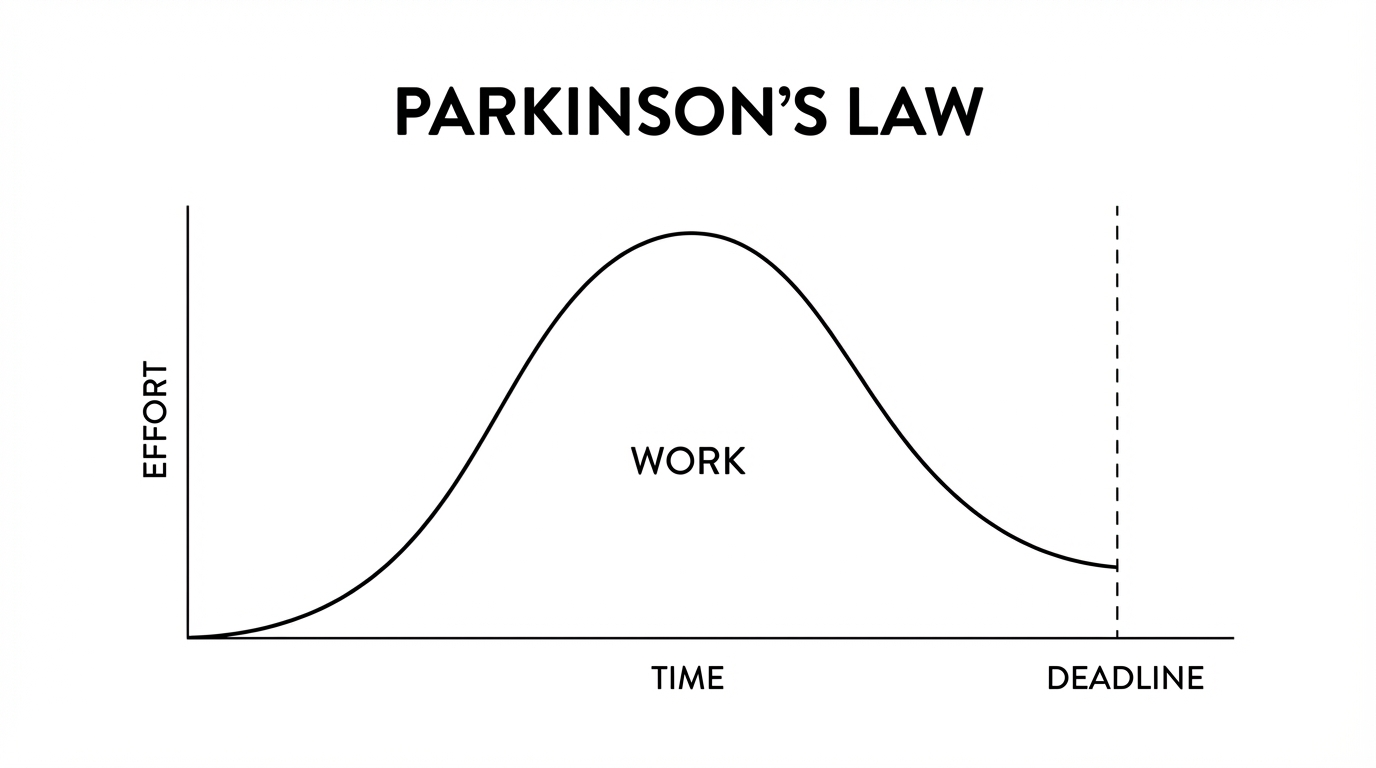
Parkinson originally wrote this to satirize the inefficiency of British bureaucracy. But the law applies with surprising accuracy to personal time management too. His example of a woman whose only task for the day is sending a postcard — spending an hour choosing the card, thirty minutes finding her glasses, and ninety minutes writing the message — sounds extreme, but we all do something similar.
If a report is due Friday, it takes until Friday. Move the deadline to Wednesday, and it's done by Wednesday. And in most cases, the quality is about the same.
Perfectionists are Parkinson's Law's biggest victims
Parkinson's Law affects everyone, but one group gets hit especially hard: perfectionists.
Most people, when they have extra time, rest or move on to something else. Perfectionists don't. When there's time left, they think, "Can't I polish this just a little more?" They can't stop at 80%. They keep pushing toward 100%, only to end up scrambling to finish right before the deadline.
Here's what that cycle looks like:
- Plenty of time ahead → "I can make this perfect"
- High expectations → Starting feels overwhelming, so you put it off
- Procrastination eats up time → Anxiety spikes, you rush to finish
- Unsatisfied with the result → "If only I'd had more time, I would've nailed it"
- The same pattern repeats next time
The starting point of this vicious cycle is the illusion that "there's plenty of time." And the thing creating that illusion is Parkinson's Law.
According to research from the American Psychological Association (APA), the excessive task-switching and time estimation failures in this pattern can erode up to 40% of your productivity. That feeling perfectionists know all too well — "I was busy all day, but I have nothing to show for it" — is backed by real numbers.
Timeboxing: How to use Parkinson's Law in reverse
Once you understand Parkinson's Law, the solution becomes clear. If work expands to fill the time you give it, put your time in a box. That's timeboxing.
The key to timeboxing is changing the question.
- ❌ "How much time do I have for this?"
- ✅ "How much time will I give this?"
The moment you stop asking "When is it due?" and start asking "How many hours is this actually worth?" — you begin to break free from Parkinson's Law.
When you set intentionally short time constraints, your brain focuses on what's essential. The energy you used to spend choosing fonts, rewriting sentences five times, and structuring the perfect outline converges on one thing: delivering the core message.
For perfectionists, this is the most powerful sentence you can internalize:
Finishing at 80% is always better than endlessly chasing 100%.
A practical timeboxing guide for perfectionists
Here's a three-step method for beating Parkinson's Law on your calendar.
Step 1. Estimate the actual time needed
Change one habit when you write down your tasks. Next to each one, note: "How many minutes does this actually take?"
Most things are smaller than you think.
- Clearing emails: 15 minutes
- Drafting a proposal: 45 minutes
- Writing up meeting notes: 20 minutes
- Batch-replying on Slack: 10 minutes
Perfectionists tend to overestimate. You might think "A proposal needs at least 3 hours," but the actual typing time might be under an hour. The rest goes to deliberating, revising, and revising again.
Step 2. Place timeboxes on your calendar
Create blocks on your calendar that match your estimates — and nothing more. The key is to intentionally reduce buffer time.
If a task takes 45 minutes, make a 45-minute block. The moment you think, "Better set aside 2 hours just in case," Parkinson's Law kicks back in.
Break large tasks into smaller pieces. Instead of a vague block labeled "Write proposal," try "Outline the proposal – 15 min," "Write first draft – 30 min," "Insert data – 20 min." The ambiguity disappears, and starting becomes easy.
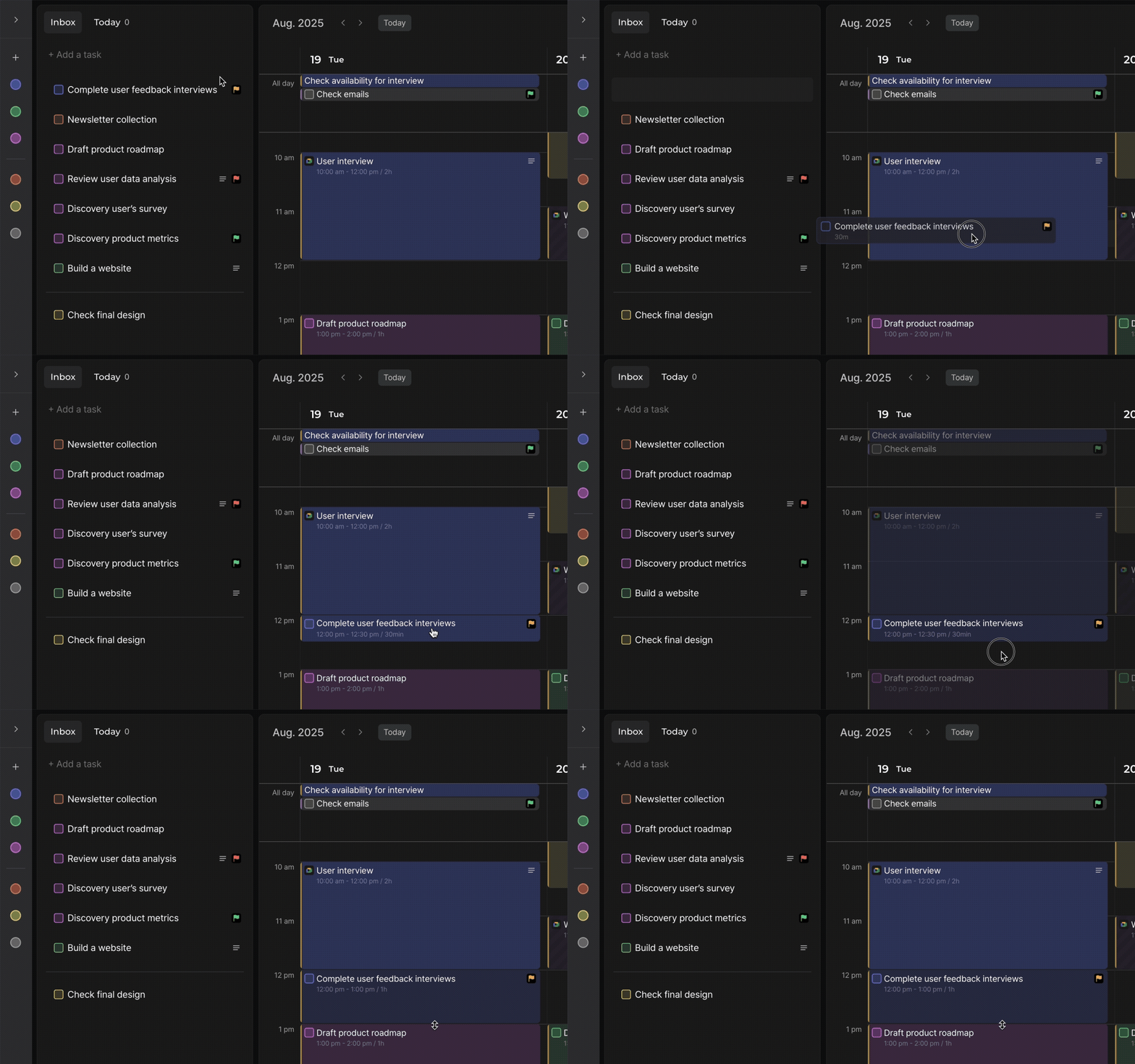
If you use Arch Calendar, this process feels even more natural. Drop any task that comes to mind into the Inbox, then drag it onto your calendar to turn it into a time block. The moment a "thought in your head" becomes "a commitment on your calendar," a deadline is automatically born.
Step 3. When the timebox ends, stop
This is the most important rule. When the timebox is up, practice stopping — even if it's not perfect.
This is the hardest part for perfectionists. The temptation to say "Just a little more" comes every time. But the skill of stopping is the skill of finishing. A proposal that's 80% done in 45 minutes is far more valuable than one that's 97% done after 3 hours but never submitted because "it's still not good enough."
The more you practice stopping, the better your time estimates become. At first, a 45-minute estimate might actually take 60 minutes. That's fine. Simply noticing that gap is growth. After a few weeks of this, you'll be able to predict how long your tasks take with surprising accuracy.
Using Arch Calendar's Analytics alongside this process makes it even clearer. It shows you exactly where your time went last week, in numbers — so you can assess time per task based on data, not gut feeling. When you're grounded in data instead of instinct, the perfectionist's anxiety eases considerably.
A quick Parkinson's Law checklist you can use today
Here's a checklist you can apply starting right now.
Stage 1: Task design
- Ask "How many hours is this actually worth?" instead of "When is it due?"
- Break big tasks into small pieces to eliminate vagueness
Stage 2: Time constraints
- Set your own deadline 1–2 days before the official one
- Apply timeboxing to each task: decide exactly how much time you'll spend, and finish within it
Stage 3: Focused execution
- Use the Pomodoro Technique (25-minute focus + 5-minute break) for short sprints
- Shorten meetings by 20%: 30-minute meetings become 25, 1-hour meetings become 45
Stage 4: Tool leverage
- Place tasks as time blocks on your calendar to visualize deadlines
- Use Arch Calendar Analytics to review your actual time usage patterns
A perfect day isn't a day where you did everything
Parkinson's Law tells us an uncomfortable truth: more time doesn't lead to better results. In fact, the more time you have, the more work inflates unnecessarily — and a perfectionist's anxiety fuels that inflation.
But once you know this law, you can use it in reverse. Put timeboxes on your calendar. Simply declaring "I'm giving this task 45 minutes" is enough to make your brain zero in on what matters.
A perfect day isn't a day where you did everything. It's a day where you finished what needed to be done today.
Put a box around your time. That box will protect your day.